
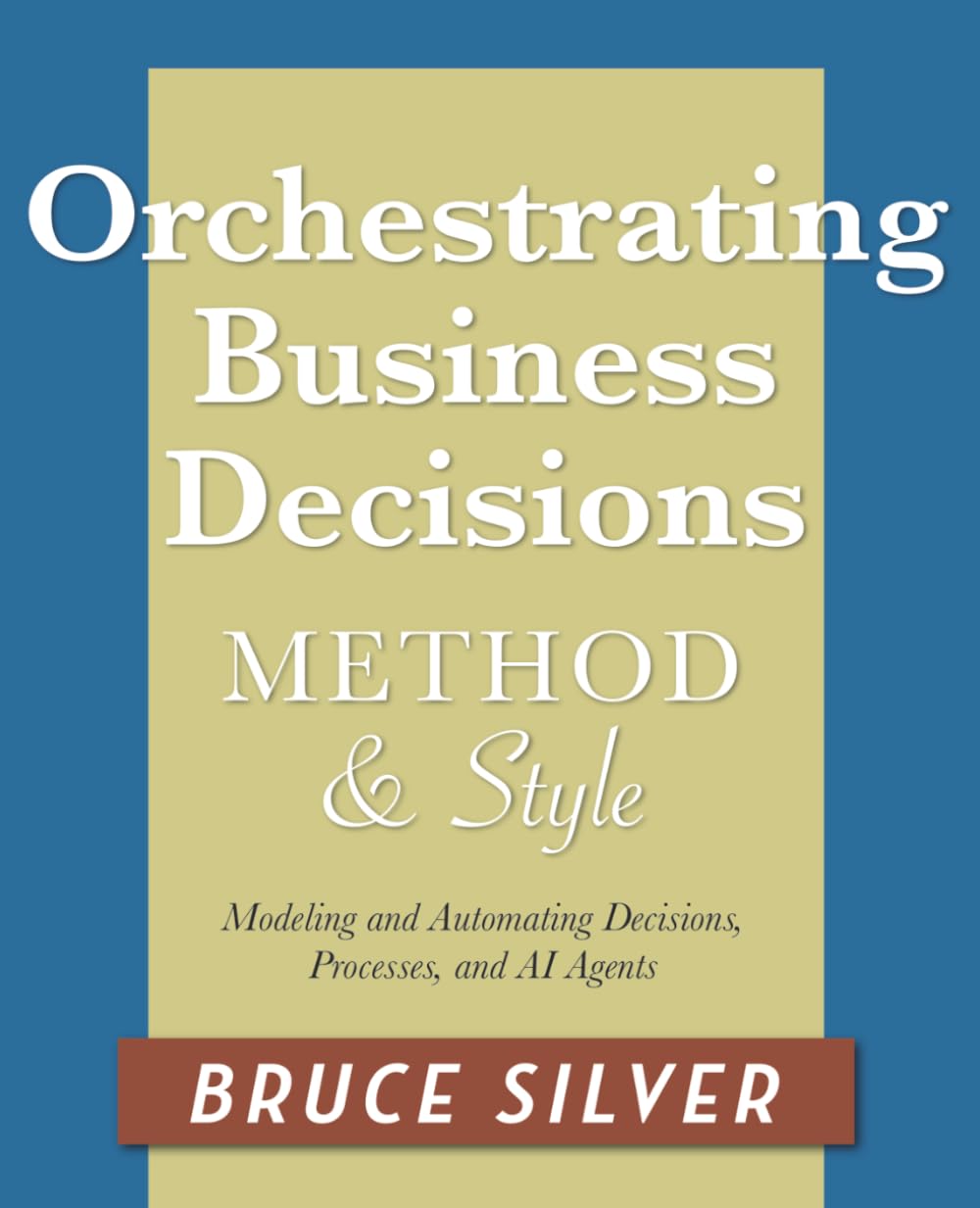
Author: Bruce Silver
Publisher: Cody-Cassidy Press
Publication Date: July 2026
Pages: 416
Overview
Building on BPMN Method and Style, DMN Method and Style, and CMMN Method and Style, this new book brings the disciplines together in a unified approach to Decision-Centric Orchestration.
Orchestrating Business Decisions Method and Style explains how decisions, processes, cases, data, business vocabulary, human participants, and AI agents can be modeled as distinct but connected components. Instead of burying business logic in application code, spreadsheets, documents, or opaque AI systems, the book shows how to make that logic explicit, understandable, executable, and governable.
The book provides a practical guide to the BPM+ family of model-based standards:
- DMN for business decisions
- BPMN for processes and workflow orchestration
- CMMN for event-driven and knowledge-intensive cases
- SDMN for shared logical data
- B-FEEL as a business-friendly expression language
Using the Trisotech Digital Enterprise Suite as the practical implementation environment, the book shows how business users and technical practitioners can transform business intent into tested and deployed decision services, processes, and cases without conventional programming.
It also addresses the growing role of artificial intelligence in business automation. AI may provide information, perform a bounded task, or operate as an agent, but it remains governed by
explicit models, business decisions, defined data structures, human oversight, and traceable execution.
The result is a disciplined approach to automation in which decisions remain visible, processes remain predictable, cases remain adaptable, and AI can be introduced without surrendering control.
Key Learning Objectives
With this book, you will learn six key aspects of Decision-Centric Orchestration:
-
Decision-Centric Orchestration: Understand how decisions, processes, cases, data, people, systems, and AI capabilities work together to produce governed business outcomes.
-
Decision Modeling with DMN: Define operational decisions using Decision Requirements Diagrams, decision tables, boxed expressions, reusable logic, decision services, and B-FEEL.
-
Process Orchestration with BPMN: Create executable workflows that gather data, invoke decisions and services, coordinate human work, react to events, and manage business outcomes.
-
Case Management with CMMN: Model long-running, event-driven, and knowledge-intensive work that cannot be reduced to a predefined sequence of activities.
-
Shared Data and Business Meaning: Use SDMN and controlled business vocabulary to maintain consistent data definitions and meaning across decisions, processes, and cases.
-
Governed Execution and AI: Integrate AI tools and agents as bounded capabilities within explicit, traceable, and accountable orchestration models.
Together, these capabilities allow business and technical practitioners to create automation that is understandable from its models, executable without conventional programming, and governable throughout its lifecycle.
Topics Include
- What is Decision-Centric Orchestration?
- Why business decisions should be treated as first-class business assets
- The modern business stack of decisions, processes, cases, data, people, and AI agents
- Context, transparency, explainability, and trust
- Real-world applications in healthcare, financial services, insurance, government, rail, agriculture, and manufacturing
- The BPM+ standards: DMN, BPMN, CMMN, and SDMN
- Moving from business intent to executable automation
- Computation Independent, Platform Independent, and Platform Specific Models
- Decision Requirements Diagrams and decision decomposition
- Decision tables, hit policies, and reusable decision patterns
- Boxed expressions and B-FEEL
- Literal expressions, functions, operators, and generalized unary tests
- Business Knowledge Models and reusable logic libraries
- Decision services and service interfaces
- Calendar arithmetic and temporal logic
- Lists, tables, filters, joins, iteration, and set operations
- Input data validation and controlled error handling
- Executable BPMN processes
- Process variables, task variables, and data mapping
- REST APIs, OpenAPI, OData, connectors, and operation libraries
- Timer, message, signal, error, escalation, and conditional events
- Case plans, stages, milestones, sentries, and event listeners
- Case files and case data
- Combining BPMN processes and CMMN cases
- Shared data models with SDMN
- Standardizing business vocabulary, concepts, and rules
- Testing, deployment, runtime inspection, and traceability
- AI as an information provider
- AI agents as bounded task performers
- Designing for AI volatility
- Governed autonomy and human escalation
- Method and Style rules for clear and maintainable automation
Preface
Method and Style has now come full circle.
It began as a way to make BPMN suitable for creating clear, model-based business requirements for process automation. Although BPMN was designed as a diagram-based execution language, business users initially adopted it mainly for documenting and improving existing processes. In automation projects, BPMN diagrams often remained rough sketches accompanying detailed text-based requirements.
BPMN 2.0 aligned the meaning of its shapes and symbols more closely with execution. But the specification alone did not provide enough guidance for business modelers to create diagrams that revealed the intended process logic clearly and completely. Method and Style addressed that gap with additional rules for creating models that were both standards-compliant and understandable from the printed diagrams alone.
CMMN extended model-based automation to work driven by events, changing information, and the judgment of knowledge workers. DMN introduced a further change. With standardized diagrams, tables, boxed expressions, and the business-friendly B-FEEL expression language, non-programmers could create executable decision logic themselves.
Real-world business automation, however, rarely consists of decisions, processes, or cases in isolation. It requires these standards, collectively known as BPM+, to work together. Decisions determine what should happen. Processes coordinate how work is performed. Cases provide the broader context for adaptive, event-driven work. Shared data and controlled vocabulary keep the models aligned.
The Trisotech platform provides the practical foundation used throughout this book. Its support for full DMN, B-FEEL, boxed expressions, executable BPMN and CMMN, shared data, testing, deployment, and governed execution makes it possible to create complete Decision-Centric Orchestration solutions without conventional programming.
The book also extends Method and Style into the age of AI. AI can support a task, produce information, or act as a task performer, but its role must remain explicit and bounded. Decision logic, orchestration, data, escalation paths, and accountability remain governed by the models.
My hope is that this book expands the adoption of these low-code techniques and helps organizations make their automated decisions, processes, cases, and AI interactions more transparent, explainable, and trustworthy.
Structure of the Book
Part I: Decision-Centric Orchestration Foundations
Chapter 1, Introduction: Orchestrating Business Decisions. Introduces the shift from activity-centric automation to Decision-Centric Orchestration. It explains the modern business stack of decisions, processes, cases, data, people, systems, and AI agents; introduces the BPM+ standards, the TRUST governance principles, the Trisotech Digital Enterprise Suite, and the Digital Enterprise Graph; and describes the progression from business intent to executable automation.
Chapter 2, Real-World Applications of Decision-Centric Orchestration. Demonstrates how model-driven orchestration is applied in healthcare, banking, insurance, government, rail, agriculture, manufacturing, and other industries. The examples show how explicit decisions and models improve agility, compliance, interoperability, operational performance, and accountability.
Part II: Decision Modeling with DMN
Chapter 3, DMN. Introduces Decision Model and Notation as a vendor-neutral, model-based language for operational decision automation. It contrasts full DMN with simplified implementations, explains the benefits of model-based decision logic, and demonstrates how DMN engages subject matter experts and supports explainable automation.
Chapter 4, Decision Requirements and DRDs. Explains how Decision Requirements Diagrams decompose a business decision into supporting decisions, input data, and knowledge sources. It covers decision naming, questions and allowed answers, datatypes, decomposition, and metadata.
Chapter 5, Decision Tables. Introduces decision-table structure, input and output entries, unary tests, rules, and hit policies. It also examines overlapping and misleading rules and presents reusable patterns such as category-score and category-with-reasons.
Chapter 6, Other Boxed Expressions. Surveys the additional standardized expression formats available in DMN, including literal expressions, contexts, relations, invocations, function definitions, conditionals, filters, iterators, and lists.
Chapter 7, B-FEEL: The Business-Friendly Expression Language. Introduces the expression language used throughout the book. It explains variables, functions, operators, base types, constraints, collections, structures, named types, XML and JSON mapping, and the handling of null values.
Chapter 8, Literal Expressions. Explores the difference between values and expressions and explains how to construct formulas using names in scope, functions, operators, string functions, number functions, formatting, and generalized unary tests.
Chapter 9, Business Knowledge Models. Shows how decision logic can be encapsulated in reusable functions called Business Knowledge Models. It explains BKM definitions, parameters, invocation, reusable libraries, imported elements, synchronization, and external functions.
Chapter 10, Contexts. Explains the two distinct forms of the context boxed expression. Contexts with a final result simplify complex decision logic, while contexts without a final result construct structured data.
Chapter 11, Decision Services. Defines the decision service as the unit of executable DMN logic. It explains service interfaces, reusable logic, delegated implementation, multistep decision logic, decision services versus BKMs, and service invocation from processes, applications, and other decisions.
Chapter 12, Calendar Arithmetic. Covers dates, times, date-times, durations, ISO 8601 formats, type conversion, date-time arithmetic, Unix timestamps, and temporal logic.
Chapter 13, Lists and Tables. Explains how DMN works with collections and structured tables without relying on SQL or conventional programming. Topics include filtering, lookup tables, table joins, iteration, column creation, membership, set operations, sorting, and replacement.
Chapter 14, Data Validation. Addresses missing, blank, mistyped, non-allowed, inconsistent, or unmatched input data. It shows how type definitions and validation services can detect errors, generate understandable messages, and prevent invalid data from producing unreliable decisions.
Chapter 15, Example: Vacation Request Validation and Approval. Brings the DMN concepts together in two complete decision services. The example validates a vacation request, calculates requested vacation days, applies approval policies, defines test cases, and deploys the completed services.
Part III: Orchestration with BPMN
Chapter 16, BPMN Basics. Introduces BPMN as the standard for orchestrating sequences of activities. It distinguishes executable from descriptive BPMN and explains tasks, subprocesses, repeating activities, gateways, events, event subprocesses, and processes exposed as services.
Chapter 17, Data and Data Mapping. Distinguishes process variables from task variables and explains data inputs, outputs, datastores, and mappings. It shows how data is passed to and from decision tasks, call activities, service tasks, script tasks, and user tasks.
Chapter 18, Operation Library. Explains how BPMN service tasks invoke REST services. It covers the use of OpenAPI definitions, manual operation entry, Trisotech connectors, and OData to expose service parameters and map them to process variables.
Chapter 19, Events. Examines executable timer, message, signal, error, escalation, and conditional events. It also covers message correlation, email, event libraries, AsyncAPI-based integrations, boundary events, and event-driven communication.
Chapter 20, Example: Vacation Request Process. Builds a complete executable process around the decision services created earlier. The process retrieves employee and holiday data, validates and approves requests, updates datastores, sends notifications, supports manual approval, captures analytic data, and is tested and deployed.
Part IV: CMMN in Decision Orchestration
Chapter 21, CMMN Basics. Introduces Case Management Model and Notation for work that does not have one predefined path from start to finish. It explains how CMMN supports event-driven, long-running, and knowledge-intensive work and provides the broader context in which processes and decisions operate.
Chapter 22, Case Plan Model. Describes the elements of a case plan, including tasks, stages, milestones, entry and exit criteria, sentries, control symbols, event listeners, file-item triggers, and diagram annotations.
Chapter 23, Case File Model. Explains the data and documents used within a case. It covers case variables, file-item definitions, lifecycle states, implicit file items, triggers, and the use of structured and unstructured information.
Chapter 24, Modeling Case Logic. Shows how to assemble case-plan and case-file elements into coherent behavior. It covers case identification, stage activation and completion, combining CMMN and BPMN, avoiding zombie states, manual termination, case end states, and the use of file items as logic elements.
Chapter 25, Example: Managing Vacation Requests. Extends the vacation scenario into a complete case that coordinates requesting, modifying, and cancelling vacation. It demonstrates how CMMN can manage multiple related BPMN processes and preserve the state of a long-running business situation.
Part V: Data, Semantics, and Meaning
Chapter 26, Unifying Model Data. Explains why DMN variables, BPMN data objects, and CMMN file items should share consistent definitions. It introduces BPM+ data unification through SDMN and addresses shared and protected data.
Chapter 27, Standardizing the Business Vocabulary. Moves beyond logical data structures to the meaning of business terms. It explains term definitions, concept models, business rules, knowledge sources, authority, and the linking of controlled vocabulary to model variables.
Part VI: Governed Execution and AI-Enabled Autonomy
Chapter 28, From Explicit Models to Governed Execution. Explains how decision, process, and case models become precise executable specifications. It shows how separating scope, logic, technology, and execution supports versioning, controlled deployment, traceability, and governance.
Chapter 29, AI as a Governed Capability. Positions AI as a capability invoked and constrained by the surrounding orchestration. AI may contribute classifications, predictions, summaries, or extracted information, or it may perform a bounded task. In both roles, explicit models retain ownership of decisions, execution paths, success criteria, and escalation.
Chapter 30, Demonstrating Governed Autonomy. Walks through an end-to-end governed AI interaction. The orchestration defines when AI is called and what data it may receive; DMN evaluates the result; uncertainty and failure trigger predefined paths; and human intervention remains an intentional part of the model.
Chapter 31, Orchestrating Business Decisions: Method and Style. Concludes with the book’s central principle: modeling is not merely documentation, it is design. Durable automation begins with explicit decisions, disciplined models, shared meaning, and controlled execution. With that foundation, processes remain predictable, cases remain flexible, and AI can be applied safely.
Praises for the book
“Bruce Silver’s Orchestrating Business Decisions is a masterful guide to the next generation of AI-powered intelligent automation. Blending deep expertise in DMN, BPMN, CMMN, plus SDMN with his proven “Method and Style” discipline, Silver shows step-by-step how to build transparent, governed, decision-centric orchestrations that integrate people, processes, data, and AI agents – without coding nor GenAI slop. Rich with real-world success stories from healthcare, finance, government, others, it is the definitive guide forward-looking leaders to leverage AI for building adaptable, scalable, explainable, and trustworthy systems of value.
Orchestrating Business Decisions is Bruce Silver’s magnum opus among his gold standard “Method and Style” series for leveraging BPMN, DMN, and their sibling standards. This is the book we desperately needed, now at this moment, to combat slop-glut with well-governed, model-driven AI development.”
Nathaniel Palmer, CEO, Infocap.ai
“As Bruce Silver aptly observes, he has “come full circle”. With Orchestrating Business Decisions, he delivers what can only be described as his magnum opus—a work that crystallizes decades of thought leadership and practical innovation.
For the first time in the history of BPM+, the full family of OMG standards—DMN - decision, BPMN - process, CMMN - case, and SDMN- data—is brought together in a single, coherent vision. Here, each discipline plays its essential role, contributing to a unified approach that advances operational excellence, accelerates business automation, and enables decision intelligence to truly flourish.
At the heart of this book lies a powerful shift: placing business people firmly at the steering wheel of their own intent. Mission, vision, and policy are no longer abstract concepts but become the driving force behind automation itself. In this paradigm, business defines the “what” and the “why”, while IT focuses on the “how”—user interfaces, service integration, data storage, and access control.
The result is a compelling blueprint for the modern enterprise: decision-driven, business-led, and technologically empowered.”
Stefaan Lambrecht, VP of Banking, Financial Services, and Insurance, Trisotech